EMT Practice Test

1. Question Content...


Question List

Question1: An IT department is decommissioning a storage array and tasks an administrator with removing a datastore from ESXi hosts.
What is a prerequisite for unmounting the datastore? (Choose the best answer.)

Question2: How does vSphere handle memory allocation during the instant clone process? (Choose the best answer.)

Question3: What is a requirement of Storage I/O Control? (Choose the best answer.)

Question4: An administrator wants to create a master copy of an existing virtual machine (VM) named "TestApp" and deploy VMs from this master copy whenever a user requests one.
Which method can the administrator use to create a master copy of TestApp? (Choose the best answer.)

Question5: Which two features are only supported by VMFS6 datastores? (Choose two.)

Question6: An administrator adds an additional host to a cluster and is attempting to remediate the configuration with a host profile.
Which option would the administrator select on the host before it can be remediated with an existing host profile? (Choose the best answer.)

Question7: An administrator is troubleshooting a recent failure and finds the following error messages:

Which action has failed, thus resulting in these errors? (Choose the best answer.)

Question8: An administrator wants to configure vCenter Server High Availability so that each node is located in a different data center.
Which requirement must be met? (Choose the best answer.)

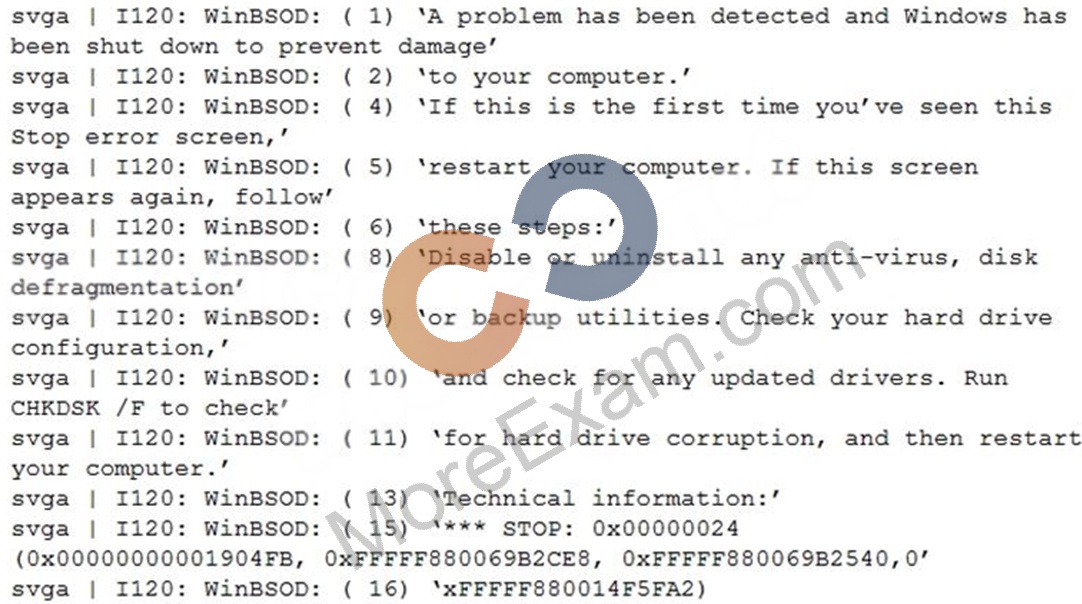
Question9: An administrator is investigating the reason for a virtual machine restarting. In the vmware.log file, the administrator finds the following error:

What is a likely cause of this virtual machine restart? (Choose the best answer.)

Question10: An administrator is unable to manage certificates with the vSphere Client.
What is another supported option that can be used to manage certificates? (Choose the best answer.)

Question11: Which two statements are true regarding the use of firmware update packages in vSphere Lifecycle Manager?
(Choose two.)

Question12: An administrator is tasked with planning an upgrade of a VMware vSphere environment to version 7.0. The platform consists of 80 ESXi hosts, logically divided into 10 clusters. The tasks will be completed by another operations team within the company.
The hardware is consistent and a single embedded vCenter Server 6.7 appliance is managing the environment.
Which statement is true regarding a suitable upgrade approach? (Choose the best answer.)

Question13: An administrator is tasked with upgrading an existing vSphere environment to version 7.0. The environment consists of mounted NFS v3 datastores. The new design requires configuration of NFS v4.1 datastores.
Which statement is true regarding this upgrade? (Choose the best answer.)

Question14: Which two configuration tasks must be performed from the vCenter Server Management Interface? (Choose two.)

Question15: Which feature is a prerequisite for Proactive High Availability (HA)? (Choose the best answer.)

Question16: Which action is supported over a VMkernel vMotion TCP/IP stack? (Choose the best answer.)

Question17: How many vSphere Trust Authority Clusters can a Trusted Cluster reference? (Choose the best answer.)

Question18: A company has one corporate datacenter (C1) and one regional datacenter (R1). There is a vCenter Server in each location. An administrator wants a central library available to C1 and R1 for all templates and ISO images.
Which two steps must the administrator take to configure the content library feature to meet this requirement?
(Choose two.)

Question19: A recently deployed set of test virtual machines are impacting the performance of a company development team project datastore. The shared cache server appears to be suffering from storage congestion.
Storage I/O Control is already enabled on all company datastores.
Which two steps should the administrator take to improve the performance of the cache server? (Choose two.)

Question20: An administrator is tasked with upgrading an existing VMware vSphere 6.5 environment to version 7.0. There are existing VMFS3 and VMFS5 datastores in the environment.
Which two statements are true regarding this upgrade? (Choose two.)

Question21: What is the minimum number of ESXi hosts required to support vCenter High Availability? (Choose the best answer.)

Question22: Refer to the exhibit.

Which two statements are true regarding the state of the virtual machine (VM) if an administrator clicks the
"Delete All" option? (Choose two.)

Question23: A host profile is updated with a new password that urgently needs to be changed on all hosts attached to the host profile.
Which option would an administrator select to complete the password change? (Choose the best answer.)

Question24: An administrator is deploying a vCenter Server Appliance and wants to join an existing vCenter Single Sign- On domain.
The administrator gathers the following information:
* FQDN of the vCenter Single Sign-On server to join
* Domain name of the vCenter Single Sign-On server being joined
* Password of the vCenter Single Sign-On server administrator account.
What other information is needed to join the existing vCenter Single Sign-On domain? (Choose the best answer.)

Question25: What is the default shutdown order of virtual machines (VMs) on a host? (Choose the best answer.)

Question26: Which feature can an administrator use for site availability with minimal effort and a low recovery point objective (RPO)? (Choose the best answer.)

Question27: In a vSphere High Availability (vSphere HA) cluster, which action does vSphere HA take when the VM Monitoring service does NOT receive heartbeats from a virtual machine (VM) in the cluster? (Choose the best answer.)

Question28: What is a pre-requisite for increasing datastore capacity? (Choose the best answer.)

Question29: An administrator has been tasked with mitigating datastore capacity issues without datastore expansion.
Which vSphere Storage vMotion migration option would achieve this mitigation? (Choose the best answer.)

Question30: An IT department is experiencing random hardware failures that are costing the company money. The CIO is looking for technical support beyond traditional break/fix with enhanced visibility and proactive insights into the environment at no additional cost.
Which VMware service meets the needs of the CIO? (Choose the best answer.)

Question31: What is the basic packaging for vSphere Installation Bundles (VIBs) and metadata in vSphere Lifecycle Manager? (Choose the best answer.)

Question32: What are two supported ESXi boot options? (Choose two.)

Question33: An administrator wants to ensure that when virtual machines (VMs) are powered on, Distributed Resource Scheduler (DRS) places them on the best-suited host. When the cluster becomes imbalanced, the administrator wants DRS to display recommendations for manual VM migration.
Which DRS automation level should the administrator select? (Choose the best answer.)

Question34: When deploying a vCenter Server Appliance, which two single sign-on (SSO)-related options are presented to an administrator? (Choose two.)

Question35: An administrator wants to be able to send vCenter Server log files to a remote syslog server and analyze logs using vRealize Log Insight.
Which step must the administrator take to meet this requirement? (Choose the best answer.)

Question36: An administrator would like to make virtual machine templates and ISO images available to all vCenter Server instances in the data center.
Which feature should the administrator use to achieve this goal? (Choose the best answer.)

Question37: An administrator places a 300 GB virtual machine named "Finance1" on a 2 TB datastore containing other virtual machines. After virtual machine placement, the datastore has 200 GB of free space. The accounting department takes a nightly snapshot of Finance1, then deletes the previous snapshot. The administrator is concerned about snapshots filling the datastore.
Which statement is true regarding snapshots? (Choose the best answer.)

Question38: There are two vSphere clusters in a company environment. One cluster is hosting development workloads and another is hosting production workloads. Both vSphere clusters are managed by the same vCenter Server.
The application team would like to move a new virtual machine from the development to production cluster with no downtime.
Which feature would allow non-disruptive movement between these two clusters? (Choose the best answer.)